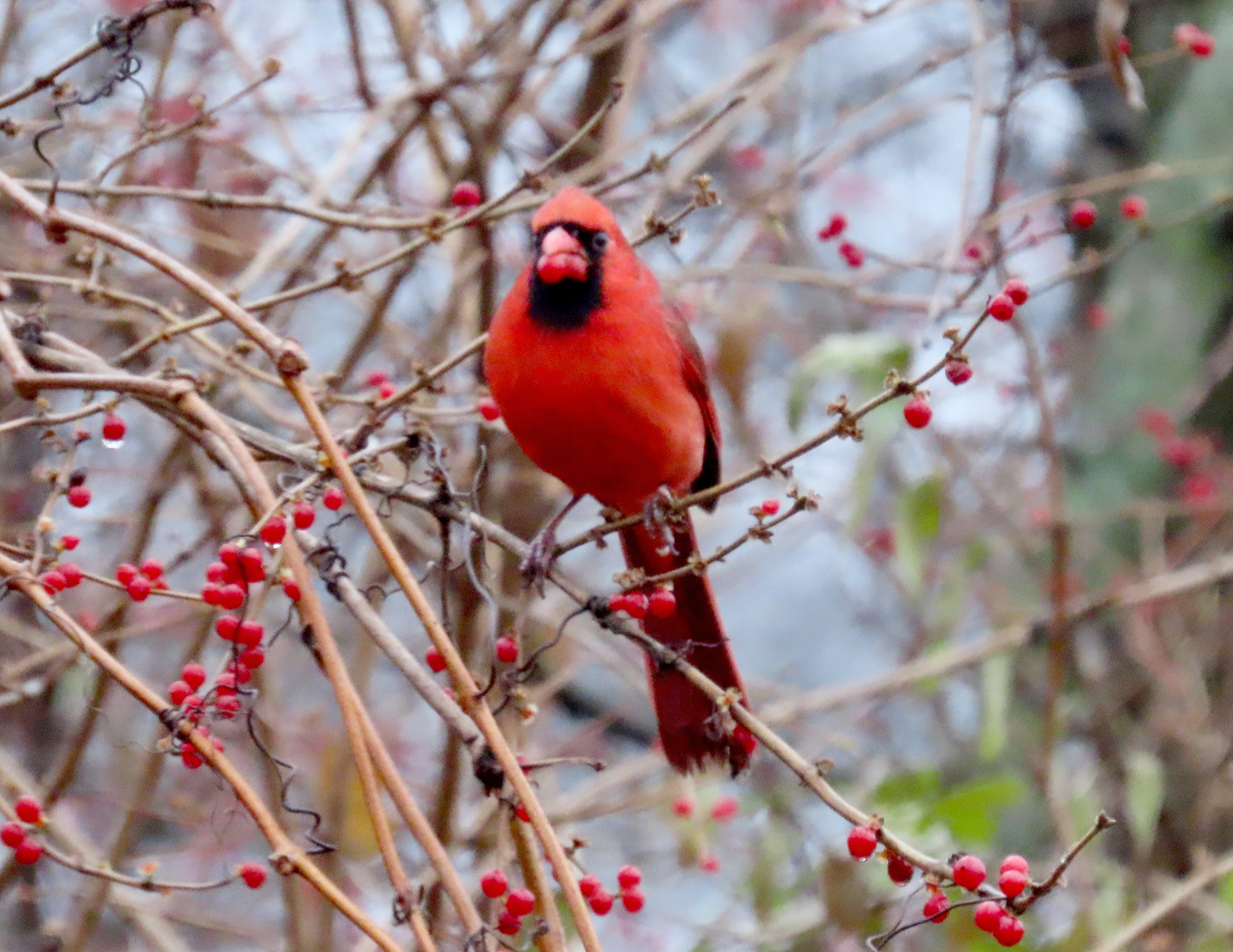
From John Trapp, Regional Editor of CBC:
The 124th Christmas Bird Count in Michigan
By John L. Trapp
For the fourth consecutive year, Michigan participants in the 124th (2023-2024) CBC
experienced relatively mild winter weather throughout the count period. This likely contributed
to a remarkable record number of 161 species, the average of the previous 10 years being just
150 species! The number of circles sampled increased from 71 last year to 75 this year. The
regional distribution of counts remains similar to previous years, with 14 in the Upper Peninsula
(UP), 25 in the Northern Lower Peninsula (NLP), and 36 in the Southern Lower Peninsula
(SLP). Mio (NLP) was new this year, Gwinn (UP) and Tuscola U.F.A. (SLP) each returned after
one-year absences, and Whitefish Point (UP) returned after an absence of several years.
Highlights include 3 species new to Michigan CBCs (Limpkin, Hammond’s Flycatcher,
European Goldfinch), 14 rarities (Ross’s Goose, Spruce Grouse, American White Pelican,
Broad-winged Hawk, Lesser Yellowlegs, Sanderling, Purple Sandpiper, Dunlin, Least
Sandpiper, Little Gull, Eurasian Collared-Dove, Palm Warbler, Baltimore Oriole, Hoary
Redpoll), and 7 species only occasionally seen on Michigan CBCs (Blue-winged Teal, Harlequin
Duck, Marsh Wren, Townsend’s Solitaire, American Pipit, Orange-crowned Warbler, Savannah
Sparrow). Read on to learn additional exciting details about the results of the 124
th CBC in Michigan.
Three New Species (i.e., reported on a Michigan CBC for the first time):
• Limpkin – 1 on 12/31 at Tuscola U.F.A. (SLP—in the Quanicassee State Wildlife Area,
where present since 10/6) was the last of an unprecedentedly massive influx into the state
beginning early July and peaking September-October, with eBird reports from an
amazing 10 counties.
• Hammond’s Flycatcher – 1 discovered by Mike Mahler and 4 others at New Buffalo
(SLP—in Warren Woods State Park) on 12/19 and seen by 4 other parties that same day,
ultimately remained through 12/23 and was reported—and thoroughly documented with
scores of photographs—on 66 eBird checklists; a new state record for Michigan.
• European Goldfinch – 1 photographed at a feeder at Au Train on 12/17 is a first winterseason report for the UP; there are 5 previous Michigan winter-season reports in the eBird
database, all from the SLP.
Fourteen Rarely Seen Species (i.e., reported in fewer than 5 of the previous 10 years):
• Ross’s Goose –2 at Albion (SLP) & 2 at Waterloo State Recreation Area (SLP) – yearly
reports in the previous 10, 25, and 50 years: 4, 7, 7;
• Spruce Grouse—1 at Whitefish Point (NP) – 3, 4, 5;
• American White Pelican—332 at Monroe (SLP) – 2, 3, 3;
• Broad-winged Hawk—1 at Traverse City (NLP) was impeccably described by an
observer with multiple years of hawk-watch experience for the first indisputable
Michigan CBC sighting – 0, 0, 4;
• Lesser Yellowlegs—2 at Rockwood (SLP) – 0, 1, 1;
• Sanderling—1 at Ludington (NLP) – 0, 1, 3;
• Purple Sandpiper—1 at Ludington (NLP) & 1 at Holland (SLP) – 3, 14, 22;
• Dunlin—2 at Rockwood (SLP) – 1, 2, 10;
• Least Sandpiper—1 at Rockwood (SLP) – 0, 0, 2;
• Little Gull—1 at Rockwood (SLP) – 1, 5, 7;
• Eurasian Collared-Dove—13 at New Buffalo (SLP) & 1 at Traverse City (NLP) – 4, 7, 7;
• Palm Warbler—1 at Marquette (UP) – 1, 1, 5;
• Baltimore Oriole – 1 at Waterloo State Recreation Area (SLP) – 3, 5, 9
• Hoary Redpoll—1 at Neebish Island-Dunbar (UP) – 3, 12, 21.
Seven Occasionally Seen Species (i.e., reported in 5 or 6 of the previous 10 years):
• Blue-winged Teal – 5 at four circles in the SLP—Battle Creek 2, Kalamazoo 1, Port
Huron 1, Waterloo State Recreation Area 1 – yearly reports in the previous 10, 25, and 50
years: 5, 12, 28;
• Harlequin Duck – 3 at three circles: singles at Eagle Harbor (UP), Ludington (NLP), and
Holland (SLP) – 5, 14, 25;
• Marsh Wren – 4 at three circles in the SLP—2 at East Lansing and singles at Kalamazoo
and Western Macomb County – 6, 13, 35;
• Townsend’s Solitaire – 3 at two circles: UP—2 at Whitefish Point, plus cw at Manistique;
SLP—1 at Barry County – 5, 12, 17;
• American Pipit – 1 at Monroe (SLP) – 6, 11, 18;
• Orange-crowned Warbler – 1 at Marquette (UP) – 5, 7, 7;
• Savannah Sparrow – 2 at Port Huron (SLP) – 5, 10, 20.
One Count Week Species (i.e., seen only during count week):
• Surf Scoter – at Rockwood (SLP) – yearly reports in the previous 10, 25, and 50 years: 9,
21, 31.
One Expected Species Missed (i.e., reported in 7 or more of the previous 10 years but not this
year):
• Eastern Meadowlark – yearly reports in the previous 10, 25, and 50 years: 7, 21, 46.
Twenty-seven Expected Species Had Geographically Limited Ranges (i.e., reported at 7 or
fewer of the 75 circles):
• Greater White-fronted Goose—28 at five circles (NLP—Bay City 16, Midland 3, Oscoda
1; SLP— Clinton 5, Sanilac 3) – yearly reports in the previous 10, 25, and 50 years: 7,
14, 17;
• Black Scoter—18 at seven circles (UP/NLP—Mackinac Straits 2; NLP—Lake Leelanau
7, Ludington 4; SLP—Berrien Springs 2, Anchor Bay 1, Coloma 1) – 10, 24, 34;
• Sharp-tailed Grouse—64 at four circles (UP—Rudyard 43, Neebish Island-Dunbar 13,
Whitefish Point 6, Les Cheneaux 2) – 10, 17, 22;
• Red-throated Loon—18 at four circles (SLP—Berrien Springs 8, Muskegon 6, New
Buffalo 3, Hudsonville 1, plus cw at Holland) – 10, 23, 29;
• Great Egret—8 at five circles (NLP—Bay City 1, Oscoda 1; SLP—Monroe 4, Detroit 1,
Western Macomb County 1) – 9, 17, 19;
• Black-crowned Night-Heron—37 at six circles (NLP—Bay City 9; SLP—Detroit River
14, Monroe 11, Albion 1, Ann Arbor 1, Rockwood 1) – 9, 22, 45;
• Turkey Vulture—15 at four circles (SLP—Pontiac 10, Battle Creek 2, Kalamazoo 2,
Clinton 1) – 10, 25, 34;
• Golden Eagle—5 at five circles (SLP—Gobles 1, Lapeer County 1, Olivet 1, Sanilac 1,
plus cw at Cass County) – 9, 20, 33;
• Northern Goshawk—4 at three circles (NLP—Mio 2, Hubbard Lake 1, Ogemaw County
1) – 10, 25, 50;
• Virginia Rail—2 at two circles (SLP—Battle Creek 1, Pontiac 1) – 8, 12, 28;
• Killdeer—14 at four circles (SLP—Monroe 19, Ann Arbor 3, Grand Rapids 1, Sanilac 1,
plus cw at Clinton) – 8, 22, 27;
• Wilson’s Snipe—2 at two circles (NLP—Lake Leelanau 1, Traverse City 1) – 7, 21, 45;
• Iceland Gull—10 at 6 circles (UP—Rudyard 3; NLP—Midland 1, plus cw at Traverse
City; SLP—Holland 2, Muskegon Wastewater 2, Port Huron 1, Sanilac 1) – 10, 21, 41;
• Glaucous Gull—25 at seven circles (UP—Rudyard 4; NLP—Hubbard Lake 2, Alpena 1,
Ludington 1; SLP—Sanilac 15, Holland 1, Muskegon Wastewater 1, plus cw at Port
Huron) – 10, 25, 50;
• Snowy Owl—1 at one circle (NLP—Manistee 1) – 10, 23, 47;
• Long-eared Owl—10 at six circles (NLP—Manistee 1; SLP—New Buffalo 3, Rockwood
3, Battle Creek 1, Grand Rapids 1, Western Macomb County 1) – 9, 22, 46;
• Eastern Phoebe—1 at one circle (SLP—Niles 1) – 7, 12, 20;
• Ruby-crowned Kinglet—6 at five circles (NLP—Midland 1; SLP—Battle Creek 2, Ann
Arbor 1, Berrien Springs 1, Waterloo State Recreation Area 1) – 10, 23, 48;
• Brown Thrasher—2 at two circles (NLP—Mio 1; SLP—Hudsonville 1) – 8, 20, 42;
• Northern Mockingbird—7 at three circles (NLP—Traverse City 2; SLP—Clinton 4,
Monroe 1) – 8, 20, 42;
• Lapland Longspur—54 at four circles (NLP—Mount Pleasant 32; SLP—Hudsonville 18,
Muskegon 3, Ann Arbor 1 – 10, 24, 48;
• Common Yellowthroat—2 at two circles (SLP—Allegan State Game Area 1, Muskegon
1) – 9, 16, 35;
• Chipping Sparrow—2 at one circle (SLP—Western Macomb County 1); 10, 18,33;
• Field Sparrow—12 at six circles (SLP—Cass County 4, Hartland 3, Waterloo State
Recreation Area 2, Clinton 1, Hudsonville 1, Sanilac 1) – 10, 25, 50;
• Rusty Blackbird—87 at six circles (NP—Au Train 1; SLP--Rockwood 54, Waterloo State
Recreation Area 22, Cass County 6, Monroe 3, East Lansing 1, plus cw at Anchor Bay) –
10, 25, 49;
• Pine Grosbeak—19 at four circles (UP—Au Train 8, Neebish Island-Dunbar 8, Whitefish
Point 2, Gwinn 1) – 10, 25, 50;
• Evening Grosbeak—48 at five circles (UP—Au Train 29, Rudyard 3; NLP—Grayling 11,
Lake County 3, Mio 2) – 10, 25, 50.
Fifteen Species Had Record-High Counts (with comparisons to previous highs):
• Greater White-fronted Goose – 28 (27 on 122nd CBC)
• Trumpeter Swan – 817 (627 on 123
rd CBC)
• American Black Duck – 3965 (3469 on 90th CBC)
• Ring-necked Duck – 2,601 (1390 on 113th CBC)
• Double-crested Cormorant – 1498 (1309 on 122nd CBC)
• Red-shouldered Hawk – 115 (111 on 122nd)
• Sandhill Crane – 12,582 (10,334 on 122nd CBC)
• Belted Kingfisher – 218 (173 on 122nd CBC)
• Yellow-bellied Sapsucker – 61 (51 on 114th CBC)
• Northern Flicker – 826 (813 on 103rd CBC)
• Merlin – 54 (45 on 121st CBC)
• Peregrine Falcon – 24 (22 on 116th CBC)
• Brown Creeper – 459 (422 on 83rd CBC)
• Winter Wren – 82 (78 on 122nd CBC)
• Carolina Wren 519 (471 on 121st CBC)
Two Species Had Lowest Counts in at Least 54 Years (with comparisons to previous lows):
• Ring-necked Pheasant – 34 (48 on 121st CBC)
• House Sparrow – 14,174 (17,706 on 118th CBC)
The Eighteen Most Abundant Species (minimum of 10,000 individuals; for context, the
median number of individuals per species was 131):
• European Starling – 119,923 at 72 circles (max of 16,689 at Ann Arbor)
• Canada Goose – 72,109 at 66 circles (max of 6059 at Bay City)
• Mallard – 41,666 at 72 circles (max of 17,500 at Anchor Bay)
• Canvasback – 38,493 at 12 circles (max of 3800 at Anchor Bay)
• Redhead – 25,286 at 24 circles (max of 17,000 at Mackinac Straits)
• American Crow – 23,478 at 75 circles (max of 3500 at Kalamazoo)
• Common Goldeneye – 19,338 at 57 circles (max of 996 at Beulah)
• Ring-billed Gull – 17,468 at 62 circles (max of 3145 at Battle Creek)
• Mourning Dove – 17,218 at 73 circles (max of 907 at Lapeer County)
• Black-capped Chickadee – 16,999 at 75 circles (max of 1107 at Ann Arbor)
• Dark-eyed Junco – 16,590 at 69 circles (max of 969 at Western Macomb County)
• Rock Pigeon – 15,292 at 72 circles (max of 1244 at Coloma)
• House Sparrow – 14,174 at 67 circles (max of 852 at Ann Arbor)
• Herring Gull – 13,339 at 58 circles (max of 2355 at Sanilac)
• Blue Jay – 12,861 at 75 circles (max of 893 at Ann Arbor)
• American Robin – 12,711 at 60 circles (max of 3533 at Ann Arbor)
• Sandhill Crane – 12,582 at 26 circles (max of 3507 at Waterloo State Recreation Area)
• duck sp. – 11,259 at 18 circles (max of 6000 at Rockwood)
• American Goldfinch – 10,087 at 75 circles (max of 656 at Ann Arbor)
The Sixteen Most Widely Distributed Species (minimum of 90% frequency, or 68 circles; for
context, the median frequency was 29%, or 22 circles)
• Hairy Woodpecker (100%) – 1081 at 75 circles (max of 72 at Ann Arbor)
• Blue Jay (100%) – 12,861 at 75 circles (max of 893 at Ann Arbor)
• American Crow (100%) – 23,478 at 75 circles (max of 3500 at Kalamazoo)
• Black-capped Chickadee (100%) – 16,999 at 75 circles (max of 1107 at Ann Arbor)
• White-breasted Nuthatch (100%) – 4252 at 75 circles (max of 401 at Ann Arbor)
• American Goldfinch (100%) – 10,087 at 75 circles (max of 656 at Ann Arbor)
• Downy Woodpecker (99%) – 3347 individuals at 74 circles (max of 308 at Ann Arbor)
• Mourning Dove (97%) – 17,208 at 73 circles (max of 907 at Lapeer County)
• Bald Eagle (96%) – 1123 at 72 circles (max of 237 at Monroe)
• Rock Pigeon (96%) – 15,292 at 72 circles (max of 1244 at Coloma)
• European Starling (96%) – 119,923 at 72 circles (max of 16,689 at Ann Arbor)
• Pileated Woodpecker (95%) – 525 at 71 circles (max of 33 at Lake Leelanau)
• Red-bellied Woodpecker (93%) – 2516 at 70 circles (max of 247 at Ann Arbor)
• Northern Cardinal (93%) – 5750 at 70 circles (max of 455 at Ann Arbor)
• Dark-eyed Junco (92%) – 16,514 at 69 circles (max of 969 at Western Macomb County)
• Mallard (91%) – 41,666 at 68 circles (max of 17,500 at Anchor Bay)
Ninety Species Had Numerical Outliers (an outlier is a count that is statistically larger than
other observations of a species seen at 11 or more circles; medians are shown for context):
• Snow Goose (median=1) – 2 outliers—Oceana 4, Tuscola U.F.A. 3 [n=11 circles];
• Canada Goose (647.5) – 3 outliers—Bay City 6059, Midland 5858, Ann Arbor 4169
[n=66];
• Mute Swan (43) – 4 outliers—Anchor Bay 325, Holland 227, Rockwood 202, Muskegon
172 [n=44];
• Trumpeter Swan (10) – 2 outliers—Battle Creek 126, Mio 70 [n=40];
• Tundra Swan (17) – 4 outliers—Huron County 1039, Anchor Bay 550, Rockwood 851,
Tuscola U.F.A. 275 [n=22];
• Wood Duck (2) – 1 outlier—Battle Creek 10 [n=13];
• Gadwall (10.5) – 3 outliers—Bay City 343, Monroe 431, Kalamazoo 188 [n=28];
• American Black Duck (7) – 7 outliers—Anchor Bay 3100, Bay City 221, Rockwood 51,
Ann Arbor 42, Midland 42, Cadillac Area 36, Mio 36 [n=48];
• Mallard (235.5) – 7 outliers—Anchor Bay 17,500, Rockwood 1852, Bay City 1697, Ann
Arbor 1232, Marquette 1171, Monroe 1056, Western Macomb County 995 [n=72];
• Northern Pintail (2) – 1 outlier—Anchor Bay 54, Bay City 32, Monroe 15 [n=13];
• Green-winged Teal (3) – 1 outlier—Monroe 34, Berrien Springs 20 [n=12];
• Redhead (18) – 4 outliers—Mackinac Straits 17000, Anchor Bay 5800, Traverse City
1125, Muskegon 450 [n==24];
• Ring-necked Duck (7) – 5 outliers—Pontiac 956, Clinton 847, Detroit River 221, Pontiac
270, Western Macomb County 267 [n=27];
• Greater Scaup (16) – 2 outliers—Rockwood 509, Traverse City 180 [n=12];
• Lesser Scaup (9) – 5 outliers—Rockwood 403, New Buffalo 170, Anchor Bay 88,
Muskegon 74, Bay City 71 [n=27];
• Long-tailed Duck (13.5) – 4 outliers—Bay City 602, Port Huron 583, Manistee 310,
Muskegon 219 [n=28];
• Bufflehead (19) – 6 outliers—Anchor Bay 790, Monroe 421, Rockwood 382, Coloma
225, Oscoda 219, Battle Creek 213 [n=58];
• Common Goldeneye (29) – 5 outliers—Beulah 996, Lake Leelanau 265, Antrim-Old
Mission 550, Mackinac Straits 242, Ludington 194 [n=64];
• Hooded Merganser (25.5) – 5 outliers—Monroe 425, Western Macomb County 255,
Antrim-Old Mission 324, Waterloo State Recreation Area 197, Mecosta County 154
[n=52];
• Common Merganser (53) – 5 outliers—Genesee County 1886, Midland 645, Cheboygan
500, Tawas 363, Antrim-Old Mission 325 [n=57];
• Red-breasted Merganser (15) – 3 outliers—Hudsonville 792, Holland 314, Monroe 252
[n=44];
• Ruddy Duck (12) – outliers—Muskegon Wastewater 280, Monroe 85, Midland 81
[n=13];
• Ring-necked Pheasant (1) – 2 outliers—Lapeer County 12, Mecosta County 4 [n=15]
• Wild Turkey (49) – 3 outliers—Little Bay de Noc 452, Clinton 343, Detroit 182 [n=66];
• Pied-billed Grebe (1) – 1 outlier—Anchor Bay 6 [n=11];
• Horned Grebe (3) – 2 outliers—Lake Leelanau 28, Antrim-Old Mission 17 [n=18];
• Great Blue Heron (5) – 4 outliers—Monroe 68, Rockwood 53, Bay City 45, Ann Arbor
28 [n=43];
• Northern Harrier (2) – 3 outliers—Rockwood 10, Anchor Bay 9, Huron County 9 [n=29];
• Sharp-shinned Hawk (1) – 1 outlier—Anchor Bay 4 [n=29];
• Cooper’s Hawk (3) – 2 outliers—Ann Arbor 32, Midland 16 [n=55];
• Bald Eagle (9.5) – 6 outliers—Monroe 237, Rudyard 99, Rockwood 40, Little Bay de
Noc 33 [n=72];
• Red-shouldered Hawk (2) – 1 outlier—Berrien Springs 11 [n=36];
• Red-tailed Hawk (16) – 4 outliers—Western Macomb County 109, Ann Arbor 85,
Waterloo State Recreation Area 75, Hudsonville 69 [n=65];
• Rough-legged Hawk (3) – 5 outliers—Sanilac 21, Neebish Island-Dunbar 17, Carney 11,
Les Cheneaux 8, Little Bay de Noc 7 [n=41];
• Sandhill Crane (148.5) – 4 outliers—Waterloo State Recreation Area 3507, Olivet 3461,
Dowagiac 1242, Waterloo State Recreation Area 2318 [n=26];
• Bonaparte’s Gull (10) – 1 outlier—Rockwood 332 [n=16];
• Ring-billed Gull (75.5) – 7 outliers—Battle Creek 3145, Monroe 1427, Detroit River
1214, Olivet 1137, Cass County 1070, Genesee County 967, Rockwood 963 [n=62];
• Herring Gull (67.5) – 9 outliers—Sanilac 2355, Detroit River 1506, Little Bay de Noc
1263, Rudyard 800, Port Huron 745 [n=58];
• Great Black-backed Gull (6) – 1 outlier—Anchor Bay 45 [n=13];
• Rock Pigeon (145.5) – 6 outliers—Coloma 1244, Detroit River 894, Little Bay de Noc
718, Berrien Springs 688, Ann Arbor 586, Alpena 600 [n=72];
• Mourning Dove (173) – 12 outliers—Sanilac 1183, Lapeer County 907, Clinton 853,
Mount Pleasant 867, Bay City 851, Pontiac 652, Anchor Bay 650, Hartland 645, Western
Macomb County 630, Waterloo State Recreation Area 625, Ann Arbor 608, Sanilac 604
[n=73];
• Eastern Screech-Owl (3) – 3 outliers: Rockwood 27, Ann Arbor 25, Anchor Bay 22
[n=41];
• Great Horned Owl (3) – 1 outlier—Ann Arbor 17 [n=45];
• Northern Saw-whet Owl (1.5) 1 outlier—Ann Arbor 4 [n=14];
• Belted Kingfisher (4) – 5 outliers—Ann Arbor 23, Grand Rapids 17, Battle Creek 14,
Kalamazoo 13, Monroe 12 [n=43];
• Red-headed Woodpecker (4) – 1 outlier—New Buffalo 23 [n=35];
• Red-bellied Woodpecker (23) – 2 outliers—Ann Arbor 247, Grand Rapids 109 [n=70];
• Yellow-bellied Sapsucker (2) – 1 outlier—Niles 15 [n=20];
• Downy Woodpecker (32.5) – 3 outliers—Ann Arbor 308, Grand Rapids 164, East
Lansing 139 [n=74];
• Hairy Woodpecker (11) – 3 outliers—Ann Arbor 72, Grand Rapids 46, Battle Creek 40,
Midland 37, East Lansing 36, Kalamazoo 34, Hudsonville 32 [n=75];
• Pileated Woodpecker (6) – 1 outlier—Lake Leelanau 35, Battle Creek 23 [n=71];
• American Kestrel (6) – 5 outliers—Hudsonville 28, Bay City 27, Clinton 25, Mount
Pleasant 25, Muskegon Wastewater 22 [n=45];
• Merlin (1) – 3 outliers—Sanilac 6, Ann Arbor 5, Western Macomb County 4 [n=31];
• Northern Shrike (1.5) – 1 outlier—Neebish Island-Dunbar 6 [n=42];
• Blue Jay (141) – 2 outliers—Ann Arbor 893, Hudsonville 517 [n=75];
• American Crow (195) – 4 outliers—Kalamazoo 3500, East Lansing 1616, Ann Arbor
1360, Sanilac 1069 [n=75];
• Common Raven (13) – 5 outliers—Rudyard 120, Neebish Island-Dunbar 65, Hayward
Lakes 63, Houghton County 58, Les Cheneaux 51 [n=41];
• Horned Lark (5.5) – 1 outlier—Hudsonville 58 [n=20];
• Black-capped Chickadee (170) – 2 outliers—Ann Arbor 1107, Midland 704 [n=75];
• Tufted Titmouse (44) – 2 outliers—Ann Arbor 316, Grand Rapids 206 [n=61];
• Red-breasted Nuthatch (7) – 6 outliers—Grayling 108, Sanilac 90, Tittabawassee Valley
82, Beulah 40, Mio 37, Au Train 34 [n=65];
• White-breasted Nuthatch (37.5) – 6 outliers—Ann Arbor 401, Battle Creek 207, Grand
Rapids 201, East Lansing 177, Kalamazoo 169, Lapeer County 160 [n=74];
• Brown Creeper (5) – 3 outliers—Kalamazoo 28, Battle Creek 26, Midland 23 [n=66];
• Carolina Wren (10.5)– 1 outlier—Ann Arbor 118 [n=32];
• Golden-crowned Kinglet (5) – 2 outliers—Battle Creek 33, Sanilac 26 [n=62];
• Eastern Bluebird (53) – 2 outliers—Ann Arbor 240, Battle Creek 209 [n=48];
• Hermit Thrush (1) – 1 outlier—Ann Arbor 15 [n=17];
• American Robin (71.5) – 4 outliers—Ann Arbor 3553, Rockwood 1464, Monroe 836,
Allegan State Game Area 755 [n=60];
• European Starling (884) – 6 outliers—Ann Arbor 16,689, Rockwood 11,759, Lapeer
County 5584, Sanilac 5176, Western Macomb County 4542, Monroe 4309 [n=72];
• Cedar Waxwing (56) – 8 outliers—Mackinac Straits 531, Hayward Lakes 466, Ludington
282, Detroit 268, Beulah 222, Alpena 219, Allegan State Game Area 217, Cadillac Area
215 [n=59];
• Snow Bunting (30) – 2 outliers—Mount Pleasant 350, Midland 305 [n=31];
• Yellow-rumped Warbler (3) – 2 outliers—Allegan State Game Area 33, Gobles 13 [n=18]
• American Tree Sparrow (69) – 4 outliers—Bay City 548, Clinton 542, Ann Arbor 391,
Western Macomb County 368 [n=67];
• Dark-eyed Junco (157) – 1 outlier—Ann Arbor 1088 [n=69];
• White-throated Sparrow (6) – 4 outliers—Ann Arbor 176, Rockwood 137, Clinton 37,
Berrien Springs 36 [n=38];
• Song Sparrow (9) – 1 outlier—Ann Arbor 48 [n=40];
• Swamp Sparrow (3) – 3 outliers—Ann Arbor 22, Monroe 13, Waterloo State Recreation
Area 10 [n=20];
• Eastern Towhee (1) – 3 outliers—Cass County 3, Hudsonville 3, New Buffalo 2; [n=12]
• Northern Cardinal (70) – 2 outliers—Ann Arbor 455, Grand Rapids 323 [n=70];
• Red-winged Blackbird (5.5) – 2 outliers—Monroe 253, Clinton 58 [n=20];
• Common Grackle (2) – 3 outliers—Rockwood 420, Ann Arbor 219, Monroe 132 [=20]
• Brown-headed Cowbird (3.5) – 3 outliers—Ann Arbor 257, Cass County 195, Genesee
County 78 [n=16]
• House Finch (56.5) – 4 outliers—Ann Arbor 435, Hudsonville 348, Grand Rapids 289,
East Lansing 234 [n=64];
• Purple Finch (6) – 5 outliers—Lake Leelanau 42, Beulah 29, Grayling 28, Antrim-Old
Mission 21, Waterloo State Recreation Area 19 [n=50];
• Red Crossbill (5) – 1 outlier—Whitefish Point 144 [n=11];
• White-winged Crossbill (14) – 1 outlier—Grayling 97 [n=17];
• Common Redpoll (9) – 3 outliers—Houghton County 57, Beulah 56, Neebish IslandDunbar 52 [n=16];
• Pine Siskin (37) – 5 outliers—Grayling 555, Sanilac 363, Lapeer County 301, Little Bay
de Noc 279, Oscoda 272 [n=49];
• American Goldfinch (109) – 1 outlier—Ann Arbor 656 [n=75];
• House Sparrow (146) – 2 outliers—Ann Arbor 852, Western Macomb County 832
[n=67].
Fourteen Species Were Numerically Dominant in at Least One Circle (as a percentage of
total individuals; for context, the median for the 75 circles was 24.7%):
• European Starling: 39 circles (UP—Rudyard 30.5%, Hayward Lakes 24.7%, Les
Cheneaux 20.2%, Carney 19.2%; NLP—Tittabawassee Valley 29.0%, Ludington 25.2%,
Manistee 23.9%, Mio 20.2%, Petoskey 20.0%, Alpena 19.9%, Traverse City 16.5%,
Antrim-Old Mission 15.3%, Oscoda 14.4%, Ogemaw County 14.0%, Lake Leelanau
13.4%; SLP—Lapeer County 45.7%, Ann Arbor 43.8%, Berrien Springs 40.0%,
Rockwood 34.7%, Detroit 34.1%, Niles 33.0%, Allegan State Game Area 32.8%, Sanilac
32.1%, Huron County 31.0%, Coloma 29.3%, Hudsonville 29.0%, Western Macomb
County 28.6%, Monroe 27.4%, Dowagiac 27.1%, Pontiac 26.4%, Port Huron 21.9%,
Hartland 20.5%, Gobles 20.0%, Cass County 19.5%, Holland 19.2%, Tuscola U.F.A.
19.2%, Grand Rapids 17.5%, Muskegon 15.8%, New Buffalo 10.0%).
• Canada Goose: 14 circles (NLP—Midland 38.9%, Oceana 33.5%, Bay City 32.9%,
Cadillac Area 32.6%, Mount Pleasant 29.8%, Hubbard Lake 22.8%, Mecosta County
17.9%, Beulah 16.5%, Cheboygan 16.4%; SLP—East Lansing 26.7%, Albion 21.7%,
Barry County 21.5%, Clinton 21.3%, Detroit River 16.4%).
• Black-capped Chickadee: 5 circles (UP—Drummond Island 52.1%; NLP—Grayling
17.5%, Lake County 16.4%, Higgins Lake-Houghton Lake 14.8%).
• Bohemian Waxwing: 3 circles (UP—Whitefish Point 45.9%, Neebish Island-Dunbar
31.6%, Gwinn 31.3%).
• Mallard: 2 circles (UP—Marquette 28.4%; SLP—Anchor Bay 42.1%).
• Common Merganser: 2 circles (NLP—Tawas 16.6%; SLP—Genesee County 27.6%).
• Sandhill Crane: 2 circles (SLP—Olivet 50.4%, Waterloo State Recreation Area 25.5%).
• Herring Gull: 2 circles (UP—Eagle Harbor 45.6%, Little Bay de Noc 23.1%).
• Northern Shoveler: 1 circle (SLP—Muskegon Wastewater 20.4%).
• Redhead: 1 circle (UP/NLP—Mackinac Straits 85.7%).
• American Goldfinch: 1 circle (UP—Au Train 18.7%).
• Ring-billed Gull: 1 circle (SLP—Battle Creek 21.5%).
• Rock Pigeon: 1 circle (UP—Manistique 30.2%).
• American Crow: 1 circle (SLP—Kalamazoo 34.4%).
Thirty-eight Circles Recorded New Species (54% of 70 circles with a history of at least 10
counts recorded at least one new species; stated another way, 38 circles with a combined 1454
count years tallied a cumulative 63 new species):
• Five species at one (1) circle – NLP—Oscoda (White-fronted Goose, Ring-necked Duck,
White-winged Scoter, Great Egret, & Golden-crowned Kinglet);
• Three species at each of three (3) circles – UP—Les Cheneaux (American Kestrel, Great
Horned Owl, Short-eared Owl), Neebish Island-Dunbar (Greater Scaup, Ring-necked
Duck, & Long-tailed Duck); SLP—Waterloo State Recreation Area (Ross’s Goose,
Baltimore Oriole, & Red Crossbill);
• Two species at each of fifteen (15) circles –UP—Au Train (Rusty Blackbird & European
Goldfinch); UP/NLP—Mackinac Straits (Black Scoter & Peregrine Falcon); NLP—Bay
City (Greater White-fronted Goose & Yellow-rumped Warbler), Grayling (Winter Wren
& Fox Sparrow), Lake County (Tundra Swan & Common Grackle), Lake Leelanau
(Black Scoter & Hermit Thrush), Lapeer County (Common Loon & Red Crossbill),
Midland (Lesser Black-backed Gull & Swamp Sparrow), Tittabawassee Valley (Brownheaded Cowbird and Red Crossbill); SLP—Albion (Ross’s Goose & Short-eared Owl),
Allegan State Game Area (Horned Grebe & Common Yellowthroat), Genesee County
(Sandhill Crane & Yellow-bellied Sapsucker), Kalamazoo (Northern Saw-whet Owl &
Common Raven), Monroe (Least Sandpiper & Northern Saw-whet Owl), Western
Macomb County (Great Egret & Marsh Wren);
• One species at each of nineteen (19) circles – UP—Hayward Lakes (Trumpeter Swan),
Manistique (Townsend’s Solitaire), Marquette (Palm Warbler); NLP—Antrim-Old
Mission (Song Sparrow), Ludington (Sanderling), Manistee (Long-eared Owl), Petoskey
(Winter Wren), Tawas (Yellow-bellied Sapsucker), Traverse City (Broad-winged Hawk;
SLP—Ann Arbor (Black-crowned Night-Heron), Clinton (Green-winged Teal), Hartland
(Short-eared Owl), Holland (American Wigeon), Muskegon Wastewater (Common
Grackle), New Buffalo (Hammond’s Flycatcher), Olivet (Red-shouldered Hawk), Port
Huron (Savannah Sparrow), Rockwood (Lesser Yellowlegs), Tuscola U.F.A. (Limpkin).
Eleven Circles Recorded More Than 75 Species (for context, the median number of species
per circle was 59):
• 87 – Monroe (15,701 individuals)
• 86 – Rockwood (33,93)
• 83 – Ann Arbor (38,067)
• 82 – Anchor Bay (41,575)
• 82 – Battle Creek (14,655)
• 81 – Waterloo State Recreation Area (13,731)
• 80 – Traverse City (7535)
• 78 – Bay City (18,422)
• 78 – Western Macomb County (15,116)
• 76 – Clinton (12,293)
• 76 – Hudsonville (13,085)
Nine Circles Recorded >15,000 Individuals (for context, the median number of individuals per
circle was 5458):
• 41,757 – Anchor Bay (82 species)
• 38,067 – Ann Arbor (83)
• 33,933 – Rockwood (86)
• 19,833 – Mackinac Straits (53)
• 18,422 – Bay City (78)
• 16,576 – Sanilac (69)
• 15,701 – Monroe (87)
• 15,116 – Western Macomb County (78)
• 15,061 – Midland (71)
Ten Circles Had High Indices of Rarity (the index of rarity is the number of rare or
infrequently seen species as a percentage of the total number of species, with a minimum of
35%; for context, the median was 27.8%):
• 44.6% - Ann Arbor (38 of 83)
• 44.4% - Whitefish Point (16 of 36)
• 42.9% - Marquette (21 of 49)
• 42.5% - Houghton County (17 of 40)
• 40.0% - Muskegon (24 of 60)
• 39.4% - Midland (28 of 71)
• 37.3% - Ludington (22 of 59)
• 37.2% - Western Macomb County (29 of 78)
• 36.6% - Battle Creek (30 of 82)
• 35.7% - Lake County (15 of 42)
Eleven Circles Were Relative Hotspots (circles with statistically high species counts—i.e.,
outliers—as a percentage of total species, with a minimum of 10.0%; for context, the median for
all 64 circles with outliers was 4.9%):
• 44.6% - Ann Arbor (37 of 83)
• 19.8% - Rockwood (17 of 86)
• 19.5% - Monroe (17 of 87)
• 17.1% - Anchor Bay (14 of 82)
• 14.5% - Sanilac (10 of 69)
• 14.1% - Bay City (11 of 78)
• 13.6% - Little Bay de Noc (6 of 44)
• 13.4% - Battle Creek (11 of 82)
• 12.7% - Midland (9 of 71)
• 12.7% - Grand Rapids (8 of 63)
• 11.5% - Western Macomb County (9 of 78)
In closing, I wish to extend a heartfelt thank you to the 63 compilers and more than 1200
participants whose dedication made this statewide summary possible.
One topic I've never addressed in my annual CBC summaries is the regional distribution of MIchigan's wintering birds. In the following paragraphs, I've taken a stab at doing that using data from the 2023-2024 CBC. I may make this a regular component of my annual summaries. What do you think?
RELATIVE REGIONAL ABUNDANCES OF MICHIGAN’S WINTERING BIRDS
THE RESULTS:
CBC data (2023-2024) reveal that few if any species are distributed in equal abundance from north to south across the state of Michigan. Looking at 46 relatively abundant species, 13 reached peak relative abundance in the UP (Wild Turkey, Bald Eagle, Herring Gull, Rock Pigeon, Common Raven, Black-capped Chickadee, Red-breasted Nuthatch, Bohemian Waxwing, Cedar Waxwing, Red Crossbill, Common Redpoll, Pine Siskin, and American Goldfinch), 7 in the NLP (Canada Goose, Redhead, Common Goldeneye, Common Merganser, Mourning Dove, Blue Jay, and Snow Bunting), and 26 in the SLP (Mute Swan, Tundra Swan, American Black Duck, Mallard, Northern Shoveler, Canvasback, Ring-necked Duck, Bufflehead, Hooded Merganser, Red-breasted Merganser, Double-crested Cormorant, Sandhill Crane, Ring-billed Gull, Red-bellied Woodpecker, Downy Woodpecker, American Crow, Tufted Titmouse, White-breasted Nuthatch, Eastern Bluebird, American Robin, European Starling, American Tree Sparrow, Dark-eyed Junco, Northern Cardinal, House Finch, and House Sparrow).
For a description of the steps taken to derive these results, read THE PROCESS that follows. If you want to see all the gory details, check out the attached EXCEL file.
THE PROCESS:
Step 1: Identify the 11 most abundant species in each region based on the number of individuals (combining all regions, this step resulted in 21 species statewide).
Step 2: Calculate the abundance of each species identified in Step 1 relative to the 6th most abundant species in each region. The 6th most abundant species were: UP (Mallard), NLP (American Crow), SLP (Dark-eyed Junco).
Step 3: Identify the region in which each of the species identified in Step 1 achieves peak relative abundance (bold-faced and highlighted in YELLOW). These 21 species are the SUPER ABUNDANT.
Step 4: In each region, add all other species whose abundance relative to the 6th most abundant species is at least 10% (combining all regions, this step added another 25 species, bringing the total to 46).
Step 5: Calculate the abundance of each species added in Step 4 relative to the 6th most abundant species in each region.
Step 6: Identify the region in which each of the species added in Step 4 achieves peak relative abundance (highlighted in ORANGE). These 25 species are the MODERATELY ABUNDANT.
To view the results of this 6-step process, click on the attached Excel file.
John L. Trapp
Michigan Regional CBC Editor
4776 Erie Drive
Buchanan, MI
(269) 697-0708
Thank you, John for this outstanding summary!