The 43rd Monroe, MI Christmas Bird Count did not start in a promising way. As I packed the car a steady rain fell on an already-saturated ground. By the time I reached Wm. C. Sterling State Park at 4 am a steady downpour had me questioning my reason for getting up. Still, I headed to my usual haunt near the boat ramp and waited for the rain to slow.
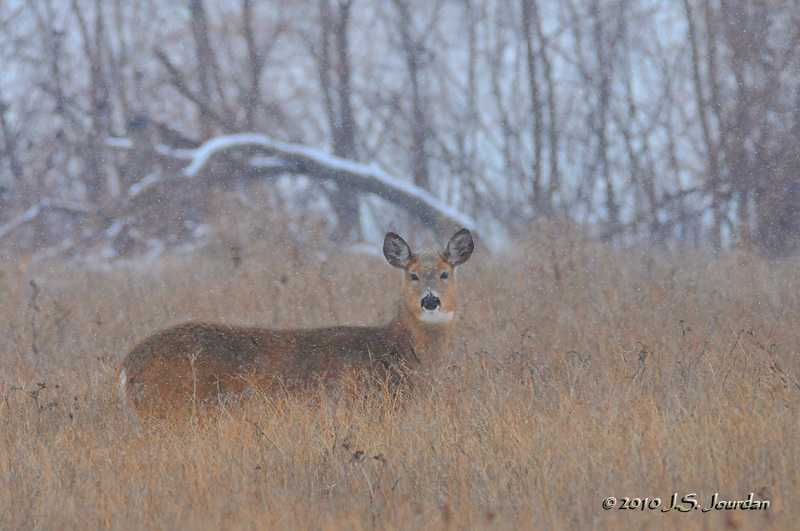
After a half-hour I got out and played a Screech Owl call, to no avail. A White-tail Deer crashing through the trees nearby nearly stopped my heart, though. After waiting a few more minutes I tried again, this time succeeding in bringing a very quiet tremolo into audio range just on the other side of the fence. Try as I might, I couldn't bring the tiny visitor into sight, but had to settle for a nice few minute conversation w/ it. With the rains starting again I decided to head off for breakfast. I'd be meeting Allen Chartier, Will Weber, Mary Trombley and Patrick Jakel at the J.R. Whiting Power Plant for the morning count.
By 7 am the skies were clearing, and the rains appeared to be moving out. Temps were already at 50 degrees Fahrenheit, with 60 degrees expected by day's end. We headed to the Lake Erie shoreline at the foot of Erie Rd. in southern Monroe Co. and waited for enough light to begin scanning the lake. By the time we had enough light the ducks were already moving.
Large flocks of 100 - 300 birds were moving along the horizon and just within limits of scope views. We could only assume they were scaup sp. (mostly Lesser Scaup), and had to settle for counts in the 7500 range. Soon we would tally the first Great Black-backed Gulls, Common Goldeneye, Mallard, Black Duck, Great Blue Heron, and a scattering of Herring and Ring-billed Gulls. A chattering pair of Northern Cardinals, along w/ Winter Wren and White-throated Sparrows were being heard in the woods nearby.
We headed to the warm water discharge outfall and climbed the hill to the service road surrounding the plant, and scanned the canal on the other side of the fence. A pair of drake Wood Ducks were accompanying a pretty hen, while a Belted Kingfisher roosted on the rail overlooking the water discharge. I managed a few digiscoped images through the fence in the early light.
Back on the shoreline we spotted the first Lesser Black-backed Gulls. An adult w/ three immature birds. I grabbed a video, knowing that we'd need documentation of the immature birds. Two birds looked like 2nd winter birds (uniform dark backs w/ white tails and black terminal bands), while 1 looked to be a first winter bird (lighter brown w/ speckled tail, all-dark bill and black terminal band on tail). The adult bird (3rd winter or later) was darker gray than the Ring-billed Gulls w/ clean yellow bill, white tail, and darkish smudge around the eyes.
Passerines were quiet along the shoreline trees. We picked up Golden-crowned Kinglet and a Downy Woodpecker, plus a couple of Bald Eagles. Will managed a couple of Horned Larks in the open field. The marshes north of the Erie Marsh Preserve were low, with exposed mudflats and American Lotus pods everywhere. We managed a nice assortment of Green-winged Teal, Northern Pintail, Gadwall, Mallard, Hooded Merganser, and more Great Blue Herons.
Returning to the lake we walked south along the shoreline for about a half-mile, then turned back. Large rafts of Common Goldeneye and Bufflehead were far off the distance, and that was about it. We couldn't stir any sparrows out of the phragmites, so we headed back to the Lady of the Lake Woods. I headed north to the Monroe Power Plant, while the rest of the gang stayed to bird the plant grounds and Erie Marsh.
At noon I met up w/ Matt Schackelford at the DTE Monroe Power Plant. We were soon joined by Tim Walsh, Don Burlett, Mike McCullough, Matt's co-worker Dan, and his girlfriend Linda. While waiting for them I had a chance to photograph a pair of Bald Eagles soaring overhead, and digiscope a cooperative Belted Kingfisher on one of the power lines.
1st winter Great Black-backed Gulls
The tour around the power plant would prove to be somewhat quiet. Gulls were scarce along the warm-water discharge canal, and finding even American Tree Sparrows would prove to be difficult. No Great Egrets would be seen this year. Along the Lake Erie shoreline we would find no ducks - just a scattering of Great Black-backed Gulls, Double-crested Cormorants, and Herring Gulls.
We did do well with Bald Eagles, though. Dozens of immature and adult birds lined the trees along the shoreline and soared overhead. I even managed some decent digiscoped images for a change.
Over at the fly-ash ponds we would pick up Red-tailed Hawks, flocks of Bonaparte's Gulls, and herds of White-tailed Deer. Matt had indicated that Short-eared Owls were spotted several times during fall surveys, so we walked the planted grasslands looking to flush some owls. Don managed to scare up a pair of Ring-necked Pheasants, but we would dip on the owls. We did find an antler from a 10-pt. buck, and an owl pellets (assumed to be from a SEO), and I managed to find a muskrat skull w/ front teeth still intact!
We would end our day w/ little more than 25 spp. Other areas fared better, but reported few total birds. The annual blackbird migration failed to develop, so those numbers would be missed. Overall we did finish w/ 74 spp., but no reportable sightings. Birds tended to be concentrated in different parts of the count circle. All of the ducks were found in Area 2, all of the Horned Larks were found in Area 8, Robins in Area 2, Eastern Bluebirds in Area 8, cormorants in Area 6, and so on. Still, we all had great fun, and had stories to tell.
Some pics from other folks:
Mary Trombley provided these images from Area 2:
Pat Jakel, Will Weber, Allen Chartier (t-shirt!), Jerry Jourdan
copyright: Mary Trombley
Will Weber, Allen Chartier, Pat Jakel
copyright: Mary Trombley
Patrick Jakel provided these images from Area 2 and Erie Marsh:
Will Weber, Mary Trombley
Will, Mary & Jerry
Karen Potts provided these images from Area 5:
Jackie Copeland, Rita Montague, Anne Smith
copyright: Karen Potts
The Monroe, MI Christmas Bird Count will be conducted on Sunday, December 16, 2012. This coincides with the National Audubon Society 113th Christmas Bird Count.
The big news this year is that the count is FREE! There will no longer be a $5 entry fee for participants. However, there will also no longer be a 'printed' report issued by NAS. Instead, the results will be viewable by all on the web. Participants will have the ability to view all results and provide photos of their count day experience.
I will again be coordinating the count in Monroe, this year. So please let me know if you're interested. Everything you need to know is available on the links to the right of this column. Send me an e-mail if interested.
Total Birds counted = 2.9 million!
Total Species = 164
Average # Birds / Count = 70,000
Average # Spp. / Count = 73
Min # Spp. = 57 (1986)
Max# Spp. = 89 (2005)
European Starlings have dominated the Monroe CBC with most number of birds counted and (973,336) and occurrence (all 41 years). Common Grackles (319,641 / 37), Red-winged Blackbirds (262,365 / 39), Herring Gulls (243,362 / 41) and Ring-billed Gulls (190,487 / 41) round out the top five in terms of numbers / #yrs counted.
The following birds have been counted all 42 years:
European Starling Herring Gull Ring-billed Gull Common Merganser Mallard House Sparrow Mourning Dove American Tree Sparrow Common Goldeneye Great Black-backed Gull American Black Duck Dark-eyed Junco Northern Cardinal American Goldfinch Great Blue Heron Blue Jay Song Sparrow American Crow Downy Woodpecker American Kestrel Red-tailed Hawk White-breasted Nuthatch
The following birds have only been found on 1 count:
Some of the more interesting birds that have been found on 2 or more counts include the following:
Greater White-fronted Goose - 1 each in 1999, 2005 White-winged Scoter - 1 each in 2005, 2006 Thayer's Gull - 1 each in 1994, 2003 Northern Saw-whet Owl - 1 each in 1971, 1972 Vesper's Sparrow - 1 each in 1990, 1992 Brewer's Blackbird - 1 each in 1990, 1978 Snowy Owl - 1 each in 1971, 1974, 1980 Barn Owl - 2 in 1970, 2 in 1972, 1 in 1973, 1 in 1976 Evening Grosbeak - 12 in 1970, 9 in '71, 4 in '73, 8 in '77, 4 in '95 Short-eared Owl - 3 in '70, 2 in '72, 3 in '75, 3 in '76, Long-eared Owl - 10 in '70, 9 in '72, 1 in '73, 1 in '75, 1 in '82
Records like these are not possible w/o the volunteer efforts of the dozens who have participated in this event. Thank you to all who have given their time/effort to locate these birds!
Oh, what's up w/ the color coded list? The color scheme shown in the summary above is based on documentation requirements for the individual species:
Category 1: No documentation required, unless (a) new to your count or (b) observed on fewer than 10% of your counts, in which case documentation may be as little at 3-4 sentences describing the bird and where found.
Category 2: Documention must be at least a paragraph or two describing the bird in detail, as well as location and circumstances of the observation.
Category 3: Full documentation is required, including all of the information requested on the enclosed rare bird documentation form.
The following is a summary of results from each of the Areas covered by the count circle:
Saturday, 17 December 2011 marked the 42nd Monroe, MI Christmas Bird Count in conjunction with the 112th National Audubon Society CBC. A week of heavy rains, and today's constant snowfall resulted in unusually low numbers of birds (63,078). But we managed 76 species, which included two Count Week birds: Pacific Loon and Turkey Vulture. If the Pacific Loon is accepted it will be a first CBC record for Michigan! Thanks to Jan Morrow for finding the bird and documenting its presence on days 1 and 3 of the CW.
As for me, my day started at 3 am with a rude awakening by the alarm clock. Out the door by 4 am I headed south toward Monroe, but not before stopping by Roberts Rd. and Pt. Mouillee to see if I could call in a Screech Owl or two. Within minutes of getting out of the car I managed to call in two birds, neither of which I could find w/ the flashlight, so no photos could be taken. A moment later a 3rd Screech Owl started calling from nearby, but then all three ceased. They must've flown off?
I headed back to the car and drove down to Sterling St. Park, where I parked at the back of the boat launch and proceeded to call in another Screech Owl. It took about 20 minutes, but I was finally successful in bringing a bird that (again) eluded my flashlight. It finally flew off to parts unknown, and I headed in to Monroe for a quick breakfast before heading off to the Whiting Plant for the day's count.
At 7am I met Tom Schlack, Allen Chartier and Will Weber, and the three of us headed down to the Lake Erie shoreline to wait for the sun to come up. Temperature was 31ºF, and winds were calm. We were expecting snow showers later today, but for now skies looked to be clear.
As we waited for the skies to brighten we were suddenly startled by the belting sound of a Winter Wren calling just feet away from where we were standing. In this technology-driven world the immediate response was to reach for our smart phones, thinking that someone was calling us using a special ringtone. When a second Winter Wren called neared the woods, however, we realized that it was the real thing. Moments later a Carolina Wren serenaded us w/ its distinctive call. I walked over to the fence surrounding the Lady of the Lake Woodlot and heard a third Winter Wren. And suddenly they were gone!
The morning light grew, and we soon could make out rafts of Lesser Scaup several hundred strong, followed by smaller rafts of Common Goldeneye. As we scanned the lake the first Great Black-backed Gulls appears, followed by Lesser Black-backed Gulls, and scads of Ring-billed Gulls. But the dimming sunrise meant that snow was headed our way, already, and within minutes we started seeing the flurries that would not let up for the rest of the day...
We were soon met by Mark Wloch, who had seen a pair of Black-crowned Night Herons in one of the ponds next to the power plant. We headed up the banks to walk the property, and found a Belted Kingfisher and a Wood Duck tucked back under the shoreline branches of the pond, but little else. A walk through the fields south of the plant yielded a fly-over flock of Tundra Swans, followed later by a lone adult Peregrine Falcon. Having walky-talkies w/ us helped to make sure everyone was on the bird as flew over. A large flock of Gadwall in one of the rear marshes, and a total of 6 Bald Eagles was about the only other notable sightings the rest of my morning. Dark, overcast skies and falling, melting snow meant another CBC of poor photography opportunities.
After a late-morning lunch w/ Robin at McDonalds, I headed over to the Monroe Power Plant, where I met Matt Shackelford and Tim Walsh, Carri Dyl, Steffen Dyl (her son) and his friend Andrew Smith. Tom Schlack arrived and the seven of us proceeded to bird the grounds. A pair of Great Egrets along the shores of the warm-water discharge canal was a nice start, and we spotted the first of dozens of Bald Eagles lining the shoreline trees. Surprisingly, gulls were in short supply along the entire discharge canal, so it was easier to count the Great Blue Herons and Double-crested Cormorants lining the shoreline.
Steffen and Andrew soon discovered the resident deer population and began to keep personal totals of all the deer seen today. They were kept busy. Deer were everywhere. And relatively tame due to (presumed) feeding by the plant workers.
However, they were much more wary (and numerous) at the fly-ash onsite, where we counted hundreds of deer in the fields below the burms. Our only other highlights of the day were 48 Bald Eagles, 15 Great Black-backed Gulls, and 2 surprising Lesser Black-backed Gulls.
Other highlights from other areas included:
- A Red-headed Woodpecker heard by Allen Chartier in the woods next to the Whiting Plant
- A Merlin seen Dennis and Kathy Rohmeyer, Amy Hall and Nick Duvall (and photographed by Amy) in Area 3
- A dark-phase Red-tailed Hawk seen by Anne Smith, Rita Montague, Jacki Copeland, and photographed by Karen Hall in Area 5
- A flock of 185 American Robins, and a single White-crowned Sparrow in Area 6 (Jack and Janet Volker)
- A count week Turkey Vulture in Area 7 (Raisin River near Raisinville Rd), reported by Bob Pettit
- 3 Great Horned Owls and 30 Horned Larks in Area 8 (Joe and Terri Janssen, Nick and Rose Assenmacher, and Ray Rose).
Of special note is the count week sighting of the Pacific Loon by Jan Morrow in LaSalle. Jan first spotted the loon swimming in Lake Erie outside here window on Wednesday the 14th, and again on the 16th. Although we tried to get photos, the bird remained elusive, and was not seen on count day. However, we're hoping that her documentation will be accepted as the 1st CBCrecord for the State of Michigan. We are presuming that this is the same bird that has been seen since late November at Sterling State Park.
Many thanks to all who participated in the day's count. Additional images from Bob Pettit, Amy Hall and Karen Potts are below:
This year marks the 112th National Audubon Society Christmas Bird Count. The Monroe, MI (MIMO) count will be conducted on Saturday, December 17, 2011.
The menu list at right has additional information regarding the history of the count, and specifics of the Monroe CBC. If interested in joining us, please let me know at jourdaj@gmail.com. Don't worry if you are a novice birder, we'll try to match you with more experienced birders. If you live inside the count circle and can't get that day, then consider conducting a feeder watch. Just send me an e-mail with your address and your list of species seen during the day. Also, keep track of any unusual sightings seen 3 days prior to or after the count date; these birds can be tallied as part of the count week total.
Congratulations and thanks to Nate Crawford for capturing this stunning image of the American White Pelican at the J.R. Whiting Plant in s. Monroe Co. This bird represents the first CBC record of American White Pelican in MI!
Final Tally: 85 Spp. and 61,800 birds
My day began at 3 AM with a rude wake-up call from the alarm clock. Out the door at 3:50 AM I was heading off to start the 111th National Audubon Society / 41st Monroe, MI Christmas Bird Count. I was hoping to pick up an owl or two before meeting the guys at the J.R. Whiting Plant in s. Monroe Co. at 7 AM. Long story short, I dipped. I had even walked the Lake Erie shoreline and the bike path with the hopes of calling out a Screech Owl, but failed miserably.
After a quick breakfast stop at the arches, I headed toward Erie Rd. and the Whiting Plant. At 7 AM Allen Chartier and Will Weber arrived, and the three of us checked in w/ the guard shack before heading down to the Lake Erie shoreline. As we waited for the sun to rise Allen counted ~125 Great Blue Herons along the ice shelf near the warm water discharge of the power plant. The herons would flush and fly in all directions before long, so it was good that we got a count before they dispersed. Meanwhile the lake was alive with thousands of unidentifiable ducks and gulls that would have to wait for daybreak to be counted.
(L/R) Allen Chartier, Mark Wloch, Will Weber
I took a few moments to walk toward the Lady of the Lakes woods to try calling in / hearing a Screech Owl (again w/ no luck). Returning to the group I stopped to photograph Allen and Will with Mark Wloch, who had just gotten off work from the plant to join us. Mark had found and had provided stunning photos of an Orange-crowned Warbler earlier in the week, and we were hoping to add this species to today's count. Luckily, Allen and Mark had refound the bird on Friday so we could add it, Ruby-crowned Kinglet and Winter Wren to our Count Week total. Thank you, Mark for providing wonderful documentation of these three birds!
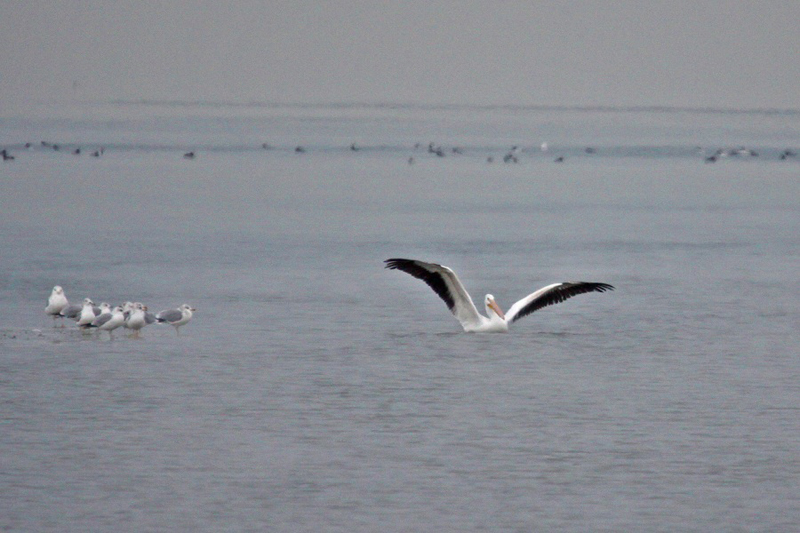
In the dim light of daybreak we scanned the open waters for identifiable spp. Allen then said, "Wholly crap, there's a White Pelican out there!". When I looked through his scope I responded, "Wholly crap there's a White Pelican!". The bird was swimming calmly among several Mute Swans, hundreds of Ring-billed and Herring Gulls, and the odd Lesser Black-backed Gull. With my digiscoping rig I was getting 1/6 sec. exposure times, and with the pelican some 200 yds. away I knew getting a decent image would be next to impossible. I managed one. So I did the next best thing and took a couple of videos of the bird with the hope of providing documentation of the bird. Will was able to get a few more keepers, (2).
We walked the shoreline down to the discharge outlet, where we found these two adorable Muscovy Ducks. Though not countable, it was fun to get a photo or two of these birds.
With enough illumination we were now able to scan the lake and pick out Lesser Black-backed Gulls, Greater Black-backed Gull, Northern Pintail, Ruddy Duck, American Black Duck, Mallard, Common Goldeneye, Canvasback, Ring-necked Duck, American Coot, Greater Scaup, and thousands of Lesser Scaup.
We then took a mile long hike south along the lakeshore, hoping to find the Orange-crowned Warbler. Though we found several Winter Wrens, Downy Woodpeckers, dozens of Golden-crowned Kinglets and Black-capped Chickadees we failed to find the warbler or Ruby-crowned Kinglet. Along the way I received a call from security telling me that they could NOT open the gate to the Lady of the Lakes woods because the lock was frozen. Meanwhile, attempts to refind the American White Pelican failed. The bird was gone, and would not be relocated (until Nate would find it later in the day).
Thanks to Mark, we were able to get the gate open and gain access to the woods. Things were quiet though, until we came upon a small flock of Golden-crowned Kinglets and Black-capped Chickadees. As we scanned the flock hoping to find a Ruby-crowned Kinglet, I spotted the Orange-crowned Warbler! I tried to get some photos of the bird as it foraged among the grape vines, but it tended to stay obscured by vegetation. Still, I was able to get enough pics to verify ID. This is only the 2nd CBC record for Michigan for this species. Additional images were provided by Allen Chartier (1), (2), (3), (4) and (5).
I had to leave and head toward the Monroe Power Plant for the afternoon count. In the meantime, Allen and Will pushed farther into the woods and managed to flush a pair of Great Horned Owls. One bird flew toward the lake, where Mark was able to get a flight shot. He would later add an American Kestrel on his way out.
I only had time to grab a drive-thru lunch, so I headed over to the foot of Front St. and pulled into the turnout to eat. While I ate, I scanned the discharge outflow and saw dozens of Mallard and Hooded Mergansers swimming. Unfortunately, it was difficult to get an accurate count through to vines covering the fence, so I pulled alongside to track the birds. A pair of Winter Wrens appeared next to the car, and one even landed on my driver-side mirror! I chased the pair along the fence, but had to settle for obscured captures w/ the camera.
At the DTE Monroe Power Plant I met up with Matt Schackelford, Tim Walsh, Don Burlett, Rose Assemacher and sons Nick and Jordan, and friend Jeremy Stotz. Bald Eagles were the draw of the day, and we hoping to be rewarded with good sightings.
We took two vehicles and headed south along the warm-water discharge canal. Golden-crowned Kinglets were actively foraging among the dried vegetation, and even the pipe-lines! Among the dozens of Great Blue Herons lining the far shoreline were even more Double-crested Cormorants. Five Pied-billed Grebes were swimming and diving in the middle of the canal, and as we searched for them a Great Egret flew along the shoreline. I was able to digiscope an image for record.
At the end of the road we were able scan the mouth of the canal from the catwalk and see dozens of Bald Eagles lining both shorelines. Unable to go further, we backtracked to the other side of the plant where Matt showed us the intake screens where a fish-kill earlier in the week shut down the entire plant! From there we headed along the Raisin River, which was frozen for the first time in many years.
The Lake Erie shoreline was frozen for a quarter mile out, so we saw no gulls, ducks or swans. In open patches of water we could make out the silhouettes of dozens of Bald Eagles. One bird actually stayed perched above us long enough to get a photo through Tim's sunroof. The coal piles to our right were covered with mixed Herring/Ring-billed Gulls by the hundreds. Other flocks of gulls would lift off the ground by the thousands, so we could only get estimated counts.
As we approached the fish dump we could see hundreds of European Starlings lining the trees ahead. A pair of White-tailed Deer were feeding next to the road and appeared oblivious to our presence. Surprisingly, four Killdeer flew in and joined the starlings among the dead fish. As we watched them a male Northern Harrier made several passes over the field.
As I photographed the Killdeer a Song Sparrow appeared nearby. The buffy coloration along its malar and sides, and reddish wings and tail made it look surprisingly like a Lincoln's Sparrow, which is not found this time of year. But a closer look showed heavy striping along the sides and a beak too thick to be a Lincoln's. Still, it was an interesting bird (for me) to photograph.
As snow started to fall more heavily we stopped at the lake and scanned dozens of Tundra Swans out on the lake. I took the opportunity to get a shot of the group.
At the mouth of the discharge canal we walked and scanned the canal, picking out Ruddy Duck, Common Goldeneye, Lesser Scaup, and Bufflehead. Golden-crowned Kinglets were actively foraging along the canal and offered nice views from a few feet away. We refound the Great Egret, and were able to get better images of it, both in flight and on the ground.
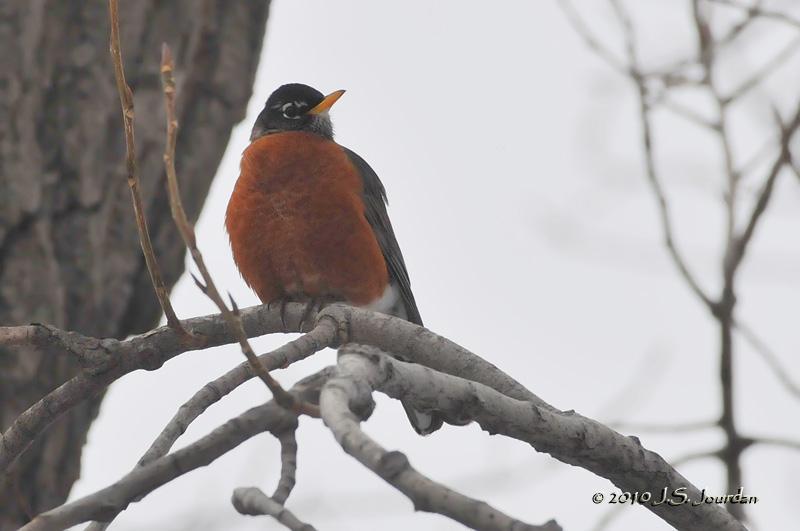
Our last stop of the day was at the fly-ash settling ponds. As we car-pooled to the Onsite, I saw Dave Mendus and Anne Smith who reported seeing a Northern Mockingbird and Fox Sparrow. Just inside the entrance (off Dunbar Rd.) we spotted another Northern Harrier, several Cedar Waxwings, and got into a flock of American Robins, Black-capped Chickadees, and White-throated Sparrows. As we scanned the flock we spotted a Red-bellied Woodpecker and a Hermit Thrush.
Continuing along the perimeter road we came across dozens of White-tailed Deer bounding along the road and feeding in the open fields. American Tree Sparrows were abundant and flying in small flocks at every turn. Northern Cardinals were also abundant. We re-spotted the harrier hunting the field to our left and managed a few photos of it as it passed by, then disappeared into the native prarie restoration.
A pass atop the burms yielded scattered flocks of Tree Sparrows among the native grasses and phragmites that lined the settling ponds. With the day's light waning it was time to head to the Michigan Bar & Grill to meet up w/ other participants and compile results.
Highlights of the count circle areas were reviewed with some interesting sightings:
83 Wild Turkeys were counted in Area 8, which also led all areas in Red-tailed Hawks (12),Mourning Doves (513) and Dark-eyed Juncos (271).
An unseasonal Tree Swallow was the highlight of Area 7, first reported earlier in the week and refound today on the Raisin River west of Raisinville Rd. 45 Snow Buntings were a high for the count circle. A Rough-legged Hawk was also one of two seen today. Karen Potts was also able to get a couple nice images of American Kestrel, American Robin, and Horned Lark.
Common Mergansers (200), American Robins (169) and Great Black-backed Gulls (45) were high counts for Area 6.
Fox Sparrow and Northern Mockingbird were highlights for Area 5. The Monroe Power Plant count yielded 156 Great Blue Herons and 63 Bald Eagles (16 adults and 47 juveniles).
Six Eastern Bluebirds and 3 Winter Wren were highlights in Area 4.
Area 3 had high count for Horned Larks (135) and most raptors, including a nice Rough-legged Hawk.
Area 2 (Whiting Plant/Erie Marsh) once again provided the most species (63) with notable birds being the American White Pelican and Orange-crowned Warbler, 37 Swamp Sparrows, 1 Fox Sparrow, 22 Winter Wrens, 4 Great Horned Owls, 1 Wilson's Snipe, and 4 Northern Pintail. Allen Chartier provided some additional commentary on this area's totals:
"It is possible that the fish kill from several weeks ago, when the temperature dropped rather suddenly, may have contributed to the large number of birds still present at the Whiting Plant, in addition to the abundance of open water there and completely frozen water everywhere else. Away from the lakeshore, gulls were extremely sparse this year where most years they are flying overhead everywhere in our area. The number and variety of passerines along the shoreline at the plant was exceptional this year. The dominance of Ring-billed over Herring Gulls and Scaup over Common Mergansers suggests that gull and waterfowl migration had not progressed as far as in most years we've done this count.
At the Erie Marsh Preserve, they had apparently done some burning since last year, as there were some more open spots that had previously been solid stands of Phragmites. These areas seemed to be favored by greater numbers of sparrows than we normally find here, especially Swamp Sparrows. The good numbers of raptors, including 6 Red-tailed Hawks and 4 Northern Harriers, might have been taking advantage of the greater visibility of prey in the more open areas. Along the dikes, especially along the unfrozen channels leading out from the Sulphur Pond, songbirds were numerous and we saw many sparrows and Winter Wrens diving into holes in the snow, apparently to forage on the bare ground underneath, which was odd. Also unusual was the behavior of some waterfowl that were apparently hiding under ledges of ice at the base of the dikes. Near the start of the walk, we watched as two Mallards, an American Coot, and a female Wood Duck swam out from under an ice ledge that didn't appear large enough to shelter even one individual. This mixture of species was also unusual. At another spot a Mallard, three American Black Ducks, and four American Coots swam out from underneath a ledge, that appeared to extend underneath the dike but we couldn't be sure. The large number of Winter Wrens is something I can't explain...I've only had this many in a day once before, on Belle Isle in fall migration in October." - Allen Chartier
Finally, in a separate e-mail on 21 Dec 2010, Mark Wloch reported that the White Pelican is still visible at the Whiting Plant, out on open water of the lake, and appears to have been spotted by members of the Toledo, OH CBC during their count week. Mark was able to get a photo of the bird on 20 Dec 2010.
My deepest thanks go out to Mark, Nate, the Area Leaders, and all who participated in this year's count. A special shout-out to Terri and Joe Janssen, who went out after dinner and found an Eastern Screech Owl after learning that we had not recorded a single one today!
A gallery of all images submitted can be accessed here!